Most overflowing gutters are blocked, usually at the outlet above the downpipe. If a gutter is clear and still overflows, it may have lost its slope, have a joint that has dropped, take too much water from a roof valley, or have a blocked downpipe below it. Very heavy downpours can briefly overwhelm even a clear gutter.
In this guide
Is it a blockage?
Usually. Debris collects at the outlets and in low spots, water backs up behind it, and the gutter fills and spills over the front edge.
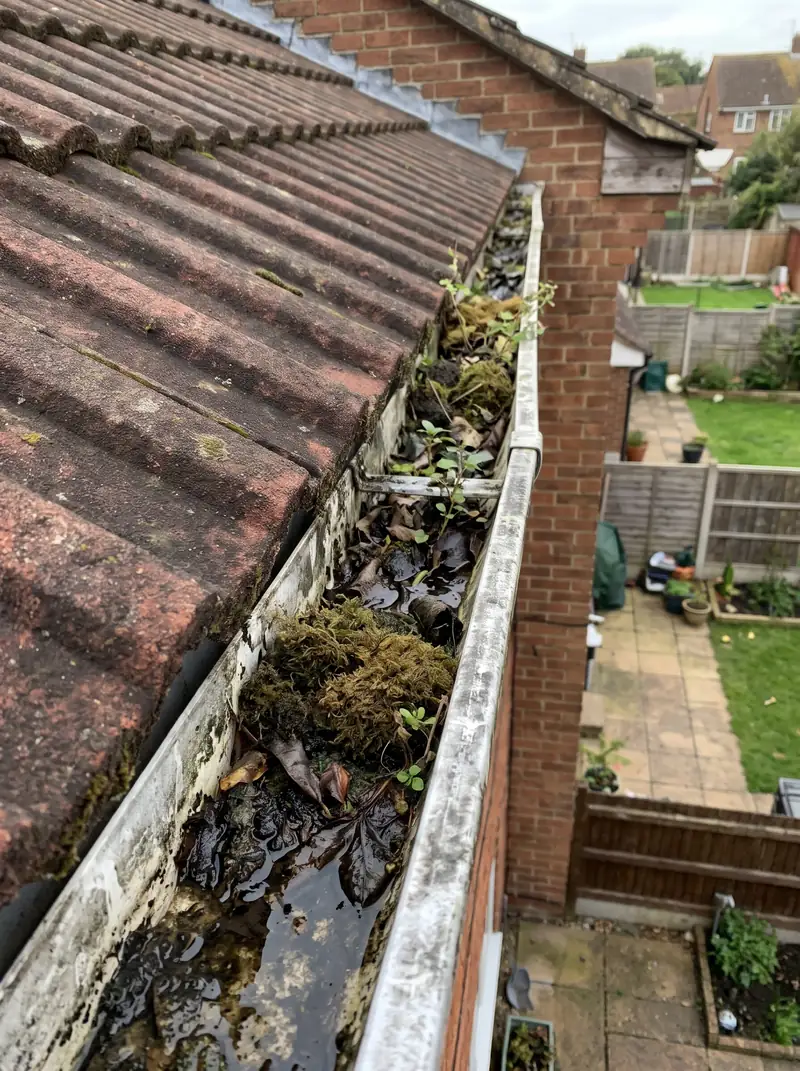
The outlet, the hole where the gutter drains into the downpipe, is the narrowest point in the system and where leaves and moss collect first. Once the outlet is covered, the gutter fills from that end. Look for overflow close to the downpipe: that is the classic pattern.
Silt along the full length of a run causes a different pattern: shallow water across the whole gutter, spilling in several places at once.
Could the gutter have lost its slope?
Yes. Gutters are fitted with a slight fall towards the outlet. If brackets have bent or a section has sagged, water pools in the low spot and spills from there.
After a gutter has been cleared, watch it in rain. If water collects and overflows in the middle of a run, well away from any outlet, the gutter has probably dropped at that point. You might see it from the ground as a gentle dip in the line of the gutter.
This is a repair, not a clean: re-setting or adding brackets. Your gutter cleaner should be able to tell you if they see it, but repairs are a different job.
What about roof valleys and corners?
A valley, where two roof slopes meet, funnels a lot of water into one short stretch of gutter. In a downpour, that spot can overflow even when the gutter is clear.
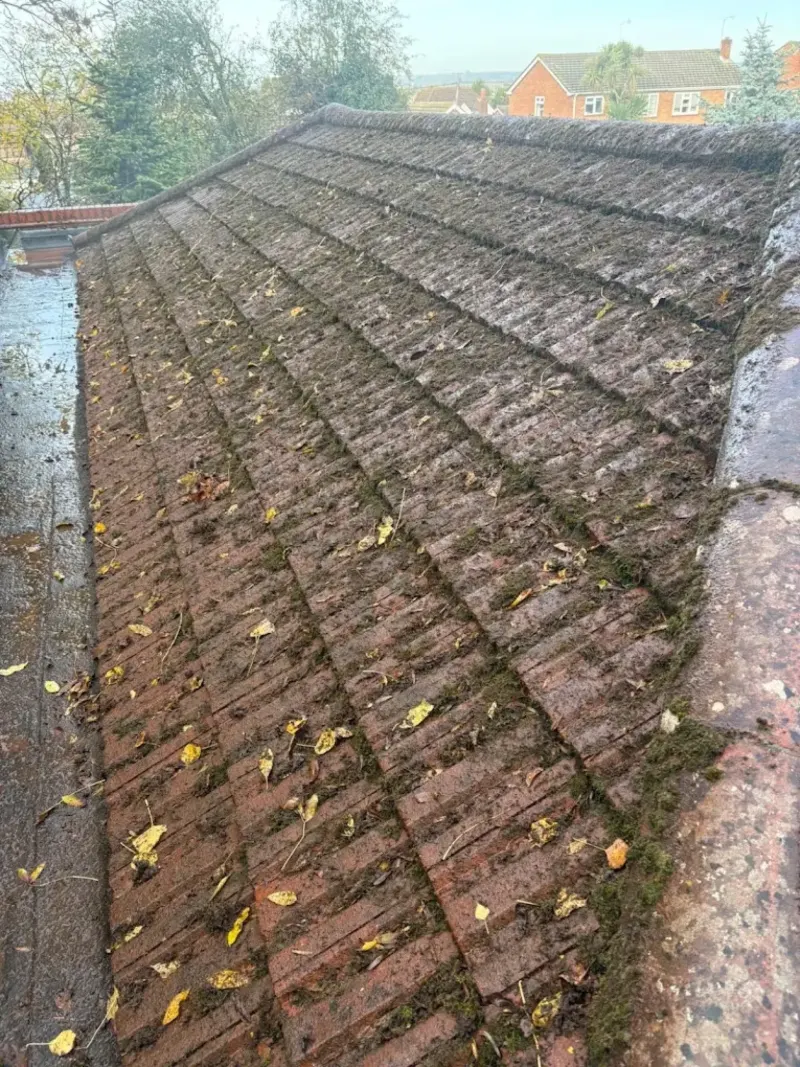
Valleys collect leaves and moss too, and wash them straight into the gutter below. Internal corners, where two gutters meet at a right angle, are similar. If your gutter overflows only at the bottom of a valley, check the valley itself and the corner piece below it. Our photo above shows the sort of debris that collects there.
Could the downpipe be the problem?
Yes. If the downpipe is blocked partway down, the gutter above can’t drain however clear it is.
A quick test: in rain, does water come out of the bottom of the downpipe? If not, or only a trickle, the blockage is probably in the pipe, often at an offset bend near the top or at the shoe at the bottom. See blocked downpipes.
Can a gutter just be too small?
Sometimes. Extensions, loft conversions and new roof lines can send more water into a gutter than it was sized for, or leave a long run with only one outlet.
Gutter size and the number of outlets are worked out from the area of roof each one drains. When a roof changes, the gutter sometimes doesn’t. Signs are a clear gutter that overflows in ordinary heavy rain, especially on long runs with a single downpipe at one end. A roofer or builder can advise on a bigger profile or an extra outlet.
Is overflow in a cloudburst normal?
A few minutes of overflow in exceptionally heavy rain can happen with any gutter. Regular overflow in ordinary rain is the thing to act on.
Summer thunderstorms can drop more water in a few minutes than a gutter can carry. If the overflow stops as soon as the cloudburst eases, and doesn’t happen in normal rain, the gutter is probably fine. If you’re not sure, check it in a steady, ordinary downpour.
How do I work out which problem I have?
Watch where the water comes over. Near the downpipe points to a blocked outlet; mid-run points to a sag; at a valley or corner points to too much water in one spot; everywhere at once points to silt along the run.
It helps to take a short video on your phone the next time it rains properly. Walk round the house, film each run of gutter and each downpipe, and note where water comes over the edge. That one clip tells a gutter cleaner or a roofer far more than a description does, and it saves a wasted visit if the problem turns out to be a repair rather than a clean.
If the gutters have been cleared recently and the overflow is in the same place as before, it is very unlikely to be debris. That is the point to ask about brackets, joints, outlets or gutter size instead. If the gutters haven’t been touched for a year or more, start with a clear: it is the cheapest fix and it rules out the most common cause.
Key points
- Overflow near a downpipe usually means a blocked outlet.
- Overflow mid-run in a clear gutter suggests a sag or lost slope.
- Valleys and corners overflow first because they take the most water.
- A blocked downpipe stops a clear gutter draining.
- Clear the gutter first; if it still overflows, it is probably a repair.
Quick questions
My gutters were just cleaned and still overflow. Why?
Check the downpipe drains, then look for a dip in the gutter line or a joint that has dropped. If both are fine, the gutter may be undersized for the roof above it.
Does a gutter guard stop overflow?
It can stop leaves getting in, but guards can also overflow if debris builds up on top. See gutter guards.
Can overflow damage my conservatory?
Water falling from a gutter above onto a conservatory roof can stain it and, in heavy rain, overflow the conservatory’s own gutter. Clearing the upper gutter is the first step.